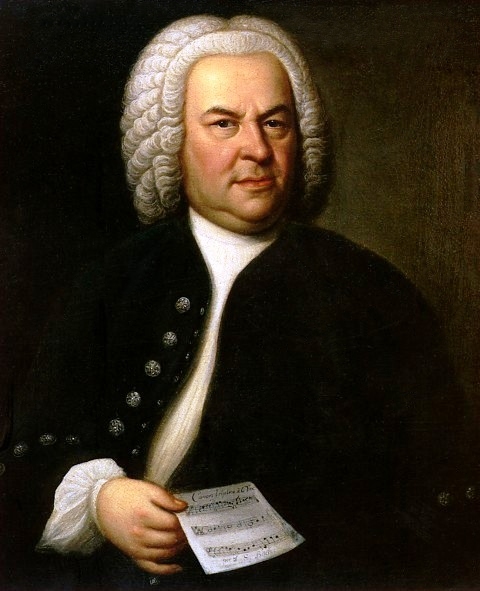
Johann Sebastian Bach
Johann Sebastian Bach[n 2] (31 March
[O.S. 21 March] 1685 – 28 July 1750) was a German
composer and musician of the late Baroque period.
He is known for his orchestral music such as the Brandenburg
Concertos; instrumental compositions such as the Cello Suites;
keyboard works such as the Goldberg Variations and The
Well-Tempered Clavier; organ works such as the Schubler Chorales and the Toccata and Fugue in D minor; and vocal music such as the St Matthew Passion and the Mass in B minor. Since the 19th-century Bach revival he has been generally regarded as one of the greatest composers in the history of Western music.[2][3]
The Bach family already counted several composers
when Johann Sebastian was born as the last child of a
city musician, Johann Ambrosius, in Eisenach. After being
orphaned at the age of 10, he lived for five years with his
eldest brother Johann Christoph, after which he continued his musical education in Lüneburg. From 1703 he was back in Thuringia, working as a musician for Protestant churches in Arnstadt and Mühlhausen and, for longer stretches of time, at courts in Weimar, where he expanded his organ repertory, and Köthen, where he was mostly engaged with chamber music. From 1723, he was employed as Thomaskantor (cantor at St Thomas's) in
Leipzig. There he composed music for the principal
Lutheran churches of the city, and for its university's
student ensemble Collegium Musicum. From 1726, he published some
of his keyboard and organ music. In Leipzig, as had happened during some of his earlier positions, he had difficult relations with his employer, a situation that was little remedied when he was granted the title of court composer by his sovereign, Augustus III of Poland, in 1736. In the last decades of his life, he reworked and extended many of his earlier compositions. He died of complications after eye surgery in 1750 at the age of 65.
Bach enriched established German styles through his
mastery of counterpoint, harmonic, and motivic organisation,
[4] and his adaptation of rhythms, forms, and textures from
abroad, particularly from Italy and France. Bach's compositions
include hundreds of cantatas, both sacred and secular.
He composed Latin church music, Passions, oratorios, and motets.
He often adopted Lutheran hymns, not only in his larger vocal
works, but for instance also in his four-part chorales and his
sacred songs. He wrote extensively for organ and for other keyboard
instruments. He composed concertos, for instance for violin
and for harpsichord, and suites, as chamber music as well as
for orchestra. Many of his works employ the genres of canon and
fugue.
Throughout the 18th century, Bach was primarily
valued as an organist, while his keyboard music, such
as The Well-Tempered Clavier, was appreciated for its didactic
qualities. The 19th century saw the publication of some major
Bach biographies, and by the end of that century all of his known
music had been printed. Dissemination of scholarship on the
composer continued through periodicals (and later also websites)
exclusively devoted to him, and other publications such as the
Bach-Werke-Verzeichnis (BWV, a numbered catalogue of his works)
and new critical editions of his compositions. His music was
further popularised through a multitude of arrangements,
including the Air on the G String and "Jesu, Joy of Man's
Desiring", and of recordings, such as three different box
sets with complete performances of the composer's oeuvre
marking the 250th anniversary of his death.
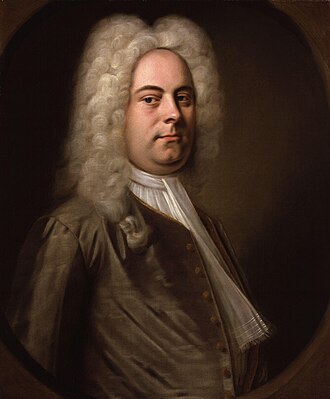
George Friedrich Händel
German-British Baroque composer well known for his operas,
oratorios, anthems, concerti grossi, and organ concertos. Handel
received his training in Halle and worked as a composer in
Hamburg and Italy before settling in London in 1712, where he
spent the bulk of his career and became a naturalised British
subject in 1727.[4] He was strongly influenced both by the
middle-German polyphonic choral tradition and by composers of
the Italian Baroque. In turn, Handel's music forms one of the
peaks of the "high baroque" style, bringing Italian opera to its
highest development, creating the genres of English oratorio and
organ concerto, and introducing a new style into English church
music. He is consistently recognized as one of the greatest
composers of his age.[5][6]
Handel started three commercial opera companies to supply
the English nobility with Italian opera. In 1737, he had a
physical breakdown, changed direction creatively, and addressed
middle class and made a transition to English choral works. After
his success with Messiah (1742), he never composed an Italian opera
again. His orchestral Water Music and Music for the Royal Fireworks
remain steadfastly popular.[7] One of his four coronation anthems,
Zadok the Priest, has been performed at every British coronation since
1727. Almost blind, he died in 1759, a respected and rich man, and was
given a state funeral at Westminster Abbey.
Handel composed more than forty opere serie over
a period of more than thirty years. Since the late 1960s,
interest in Handel's music has grown. The musicologist Winton
Dean wrote that "Handel was not only a great composer; he was a
dramatic genius of the first order."[8] His music was admired by
Classical-era composers, especially Mozart, Haydn and Beethoven.
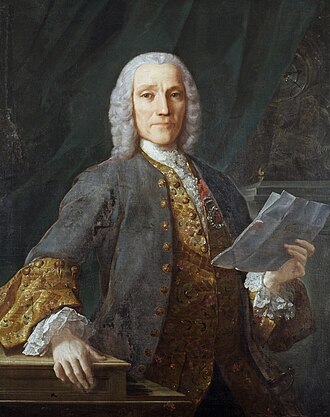
Giuseppe Domenico Scarlatti
Giuseppe Domenico Scarlatti, also known as Domingo or
Doménico Scarlatti (26 October 1685 – 23 July 1757), was an
Italian composer. He is classified primarily as a Baroque
composer chronologically, although his music was influential
in the development of the Classical style. Like his renowned
father Alessandro Scarlatti, he composed in a variety of musical
forms, although today he is known mainly for his 555 keyboard
sonatas.[1] He spent much of his life in the service of the
Portuguese and Spanish royal families.
Scarlatti was born in Naples, Kingdom of Naples,
belonging to the Spanish Crown. He was born in 1685,
the same year as Johann Sebastian Bach and George Frideric Handel.
[1] He was the sixth of ten children of the composer
and teacher Alessandro Scarlatti. His older brother Pietro
Filippo was also a musician.
Scarlatti first studied music under his father.[2] Other
composers who may have been his early teachers include Gaetano
Greco, Francesco Gasparini, and Bernardo Pasquini, all of whom
may have influenced his musical style.
Scarlatti was appointed as a composer and organist at the
Chapel Royal of Naples in 1701 and briefly worked under his
father, who was then the chapel's maestro di cappella.
In 1704 he revised Carlo Francesco Pollarolo's opera Irene
for performance at Naples. Soon after, his father sent him
Venice. After this, nothing is known of his life until 1709,
when he went to Rome and entered the service of the exiled
Polish queen Marie Casimir. It was there he met Thomas
Roseingrave. Scarlatti was already an accomplished
harpsichordist; there is a story of a trial of skill
with George Frideric Handel at the palace of Cardinal
Ottoboni in Rome, where Scarlatti was judged possibly
superior to Handel on the harpsichord, although inferior
on the organ. Later in life, he was known to cross himself
in veneration when speaking of Handel's skill.[3]
While in Rome, Scarlatti composed several operas for Queen
Casimir's private theatre. He was Maestro di Cappella at St.
Peter's from 1715 to 1719. In 1719 he travelled to London to
direct his opera Narciso at the King's Theatre.
According to Vicente Bicchi, Papal Nuncio in Portugal at the
time, Scarlatti arrived in Lisbon on 29 November 1719. There
he taught music to the Portuguese princess Maria Magdalena
Barbara. He left Lisbon on 28 January 1727 for Rome, where
he married Maria Caterina Gentili on 6 May 1728. In 1729 he
moved to Seville, staying for four years. In 1733, he went
to Madrid as a music master to Princess Maria Barbara, who
had married into the Spanish royal house. She later became
Queen of Spain. Scarlatti remained in Spain for the remaining
25 years of his life and had five children there.